
Electrifying and Decarbonizing a 500 Square Foot Apartment in Morgantown, West Virginia

One of my current projects is improving the financial and economic performance of a 500 square foot apartment in Morgantown, West Virginia.
While this apartment is hardly decisive for the global energy transition, this journey offers some insights we energy transition warriors face in electrifying and decarbonizing the world.
As such, it might be of interest to those readers who want to get something done, instead of just talking about getting things done.
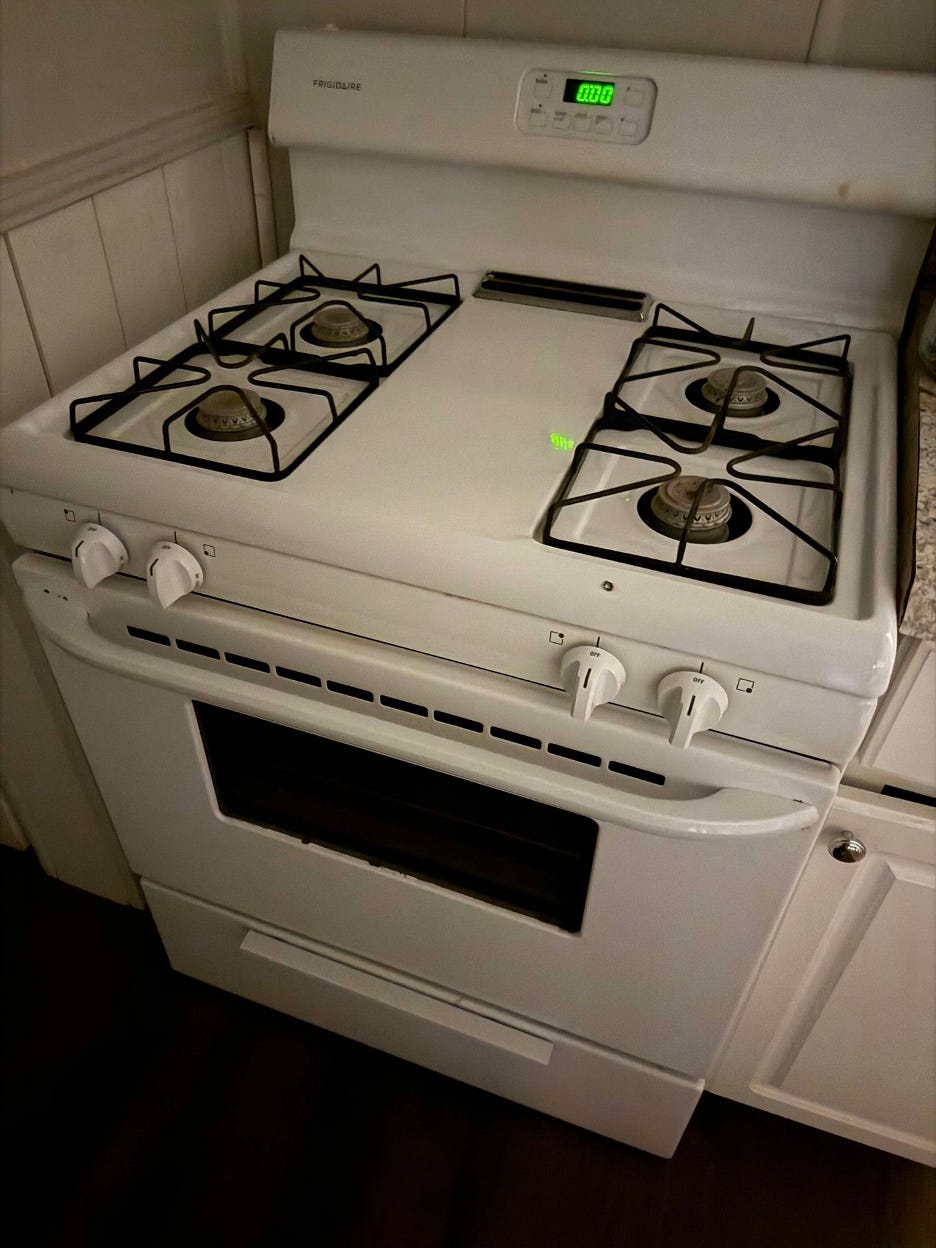
I replaced this gas stove with an electric stove in January 2026. That decision did not yield immediate gains, as I still need gas for the water heater. But I am one step closer to removing natural gas altogether from the apartment.
1. The basic setup
The apartment is attached to an old 4-bedroom house. I bought this setup with two partners back in 2022, before Papa Powell crushed my dreams of becoming a real estate tycoon with historically fast rate hikes.
The house and the apartment are listed on AirBnB and other short term rental sites. Although the real estate is a little run down, the house was not very expensive. As a result, the operation continues to be profitable.
I have already bought out one of the partners. The other partner is on his way out by the end of 2026. All that remains is paying off the mortgage, a goal I expect to achieve in 2027.
At that point, the house and the apartment are under my control, with no lender to worry about. I still need to pay property tax, but that is not a huge headache in the very red state of West Virginia.
As for energy, the house itself is heated with natural gas while the apartment is heated with inefficient baseboard heating. We also have air conditioning in both, not that much energy is needed for cooling in the cool mountain air.
The house is somewhat efficient for an old building. The apartment is an energy efficiency disaster, resulting in hundreds of dollars of heating costs in the winter months.
2. The plan
The business plan is to continue operating both the house and the apartment as short-term rentals. Together, they form a powerful combination. Between the university, the hospital, and the football weekends, demand is strong. Ours is not a premium operation, but we can accommodate large groups – and people sure pay a lot of money for that.
To improve the financial and ecological sustainability of my operation, I plan to execute the following changes over time:
Insulation of the basement apartment. This alone will save hundreds of dollars a year. I hope to start the insulation process in 2026 or 2027, depending on cost estimates from my contractor. The scope of the operation could range from simple sealing to a complete insulation of the walls and the floor.
Electrification of the basement apartment. Today, the only appliance running on natural gas is the water heater. As it ages, I plan to replace it with an electric water heater and disconnect gas. Avoiding the monthly fixed fee alone will save hundreds of dollars a year. Unfortunately, I may need to pay for some electric work to fit the water heater. Based on preliminary investigations, the electric work will cost more than the heater itself.
Replacing baseboard heating with a heat pump. Here the plan is to observe electric bills after insulation and then calculate the return on installing a heat pump. The biggest problem here appears to be the outrageous soft cost. Heat pumps are cheap but installing them is highway robbery in the United States.
Eventually, I will install solar panels on the roof of the house. This is not cheap without the federal tax credits that just expired, but I am willing to accept a low return for ecological sustainability and to remove electricity price volatility. In West Virginia, grid electricity is produced with polluting coal, so that is not something I want to rely on in the long run.
These changes should eventually save me somewhere north of a thousand dollars a year. That is not exactly life-changing money, but a modest profit for advancing the energy transition is acceptable for me.
3. Life in West Virginia
As a lifelong catastrophizer, I sometimes daydream of leaving everything behind in an emergency and retiring in the apartment myself. What a life that would be.
By my calculation, the income from the house on AirBnB – or even as a conventional rental – would be enough to support a minimalist bachelor lifestyle along the lines of Jacob Lund Fisker’s early retirement extreme. My material needs are minimal, the house is profitable, and a cup of coffee in Morgantown every now and then is not going to break the bank.
And if I need more space, I can always move into the house and rent the basement as a furnished unit to some other minimalist bachelor. That income alone would cover all my housing costs in that big house.
West Virginia is not the easiest state for sustainable living because its electric grid depends on coal. But the energy transition continues to advance, and I am confident the tide will turn eventually.
Reading this made me think of the Nowon Energy Zero House complex in Seoul. I had a chance to tour the complex before move-in as an energy industry professional invited by Seoul Energy Corporation. It’s Korea’s first zero-energy apartment development, 121 units built with passive-house-level insulation and glazing, heat recovery ventilation, rooftop PV, and geothermal heat pumps handling both heating and cooling.
Press reporting put total monthly energy fees around $28 per 39–59 m² unit, covering electricity, heating, and hot water combined, in a Seoul climate that swings from 35°C summers to -10°C winters.
The high soft cost you’re running into isn’t really a US quirk. It’s what you get whenever electrification has to pay for itself one apartment at a time instead of across a hundred at once.